
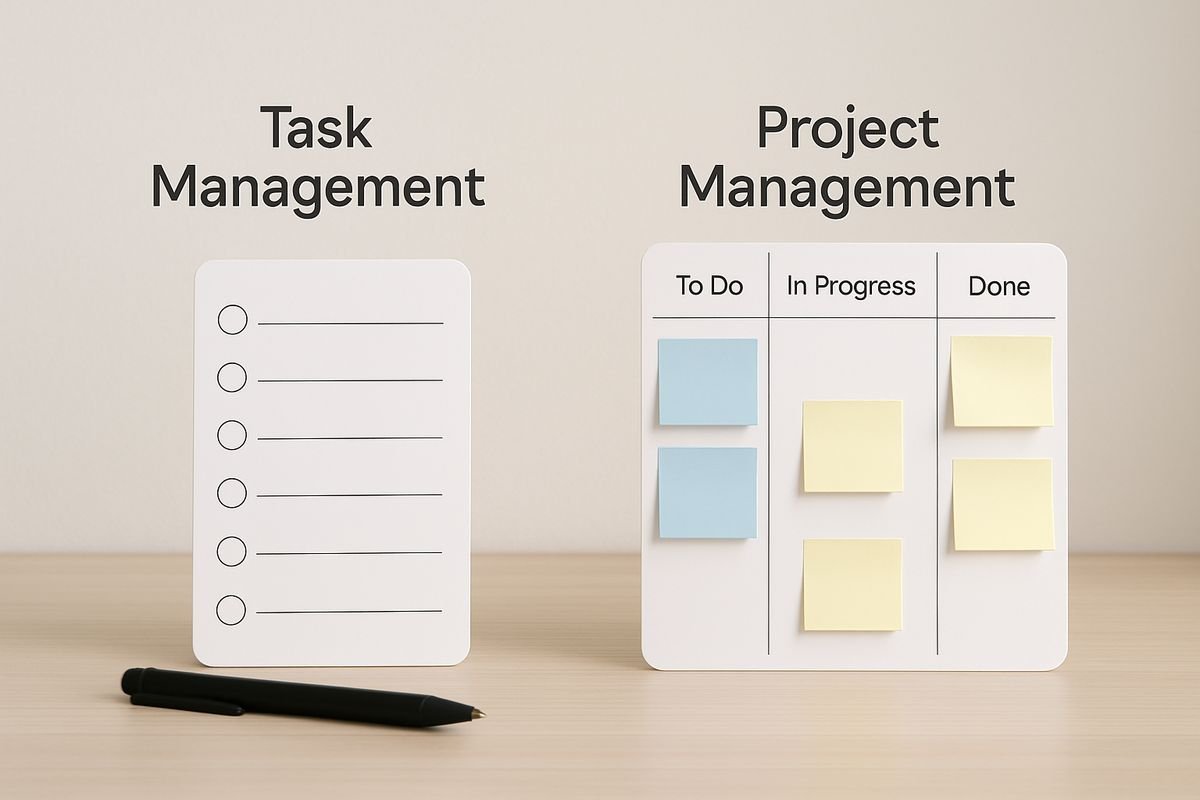
Task management vs project management is the difference between keeping work moving and making sure the right work reaches the finish line. If your team is busy but progress still feels fuzzy, understanding that distinction can save you time, protect margin, and make growth feel a lot less chaotic.
What task management vs project management actually means for your business
At a glance, task management is about controlling individual pieces of work. Project management is about coordinating many moving parts to deliver a bigger outcome. One keeps the engine running. The other makes sure the vehicle reaches the right destination, on time and without burning through budget.
That difference matters more than it sounds. If you treat a complex business initiative like a simple to-do list, you usually end up with missed handoffs, blurred accountability, and finance asking awkward questions about why costs rose before results appeared. Go too far the other way and you can turn ordinary daily work into an administrative obstacle course.
For a growing business, this is not just an operations issue. It is a visibility issue. When you know what should be handled as a task and what needs proper project structure, you get cleaner reporting, faster decisions, and fewer surprises. Which, honestly, is what most owners and finance leaders want: less chasing, more control.
Task management in simple terms
Task management is the day-to-day discipline of organising and completing individual actions. Think approvals, follow-ups, reconciliations, stock checks, customer callbacks, payroll inputs, and all the other small but necessary actions that keep your business functioning.
A task usually has a clear owner, a priority, and a deadline. Sometimes it repeats every day, week, or month. Sometimes it appears once and disappears. Either way, the point is straightforward: someone needs to do something, by a certain time, and everyone should be able to see whether it is done.
In practical terms, good task management reduces friction. People know what is expected, what matters most, and what is slipping. If your team spends too much time asking “Who’s doing this?” or “Did that get finished?”, your task management probably needs attention.
Project management in simple terms
Project management sits one level higher. It is the planning and coordination of multiple related tasks, people, milestones, resources, and timelines to deliver a defined result.
That result might be launching a new service, implementing software, opening a second site, redesigning your reporting process, or fixing a broken workflow between finance and operations. These are not single actions. They are collections of actions with dependencies, budget implications, and a real chance of going off course if nobody is steering.
Project management gives you delivery confidence. It helps you see what has to happen, in what order, by whom, and at what cost. For business owners and CFOs, that matters because poor coordination is expensive. It delays revenue, creates rework, and quietly eats margin.

The key differences between task management and project management
The simplest way to think about it is this: task management is about execution at item level, while project management is about orchestration at outcome level.
Task management asks, “Was the thing done?”
Project management asks, “Are all the right things being done, in the right order, by the right people, so the business gets the result it needs?”
That sounds subtle, but the working reality is completely different.
Scope, complexity and level of control
Task management is narrower. It focuses on specific actions and responsibilities. If one person needs to review an invoice batch by Thursday or update a supplier file by 3pm, that sits comfortably in a task-based system.
Project management handles wider objectives with more moving parts. If you are rolling out a new approval workflow across finance, operations, and department heads, that is no longer just a list of jobs. It involves planning, sequencing, communication, training, and oversight.
This is usually the point where growing businesses feel the strain. A simple list works well until work starts crossing teams. Once handoffs, approvals, and shared deadlines enter the picture, you need more than visibility into tasks. You need control over how those tasks connect.
Timelines, milestones and dependencies
A task generally has a due date. Useful, simple, and often enough.
A project has a delivery plan. That includes start and end dates, milestones, dependencies, and the sequence of work needed to avoid delays. If one task cannot start until another finishes, that relationship matters. If a delay in procurement pushes back training, and training pushes back go-live, you are in project territory.
This affects cash flow more than many teams realise. Delayed implementation can mean delayed billing. Slipping internal initiatives can mean extra contractor costs or duplicated effort. If your team needs better visibility into linked timelines, it helps to choose a system built for bigger delivery planning rather than stretching a basic checklist beyond its limits.
People, resources and accountability
Task management usually assigns one item to one owner. That is clean and effective for routine execution.
Project management goes further. It looks at workload, capacity, resource conflicts, and shared ownership across teams. It asks whether the right people are available, whether deadlines are realistic, and where bottlenecks are likely to appear.
That matters when you are scaling. You may not need another hire. You may simply need better visibility into who is overloaded, where work is stalling, and which initiatives are consuming more time than planned. Without that view, businesses often respond to operational strain by adding headcount before fixing coordination. Expensive mistake.
Success measures, reporting and business impact
With task management, success is usually binary. The task was done, or it was not. That is perfectly sensible for recurring operational work.
With project management, success is broader. Did the project deliver the intended outcome? Was it completed on time? Did it stay within budget? Did it improve efficiency, reduce risk, or support growth the way you expected?
Business owners and financial controllers need that second view. Completion alone is not enough. You need reporting that links activity to outcomes, because being busy is not the same as moving the business forward.

When task management is enough and when you need project management
This is where the decision becomes practical. You do not need formal project management for every piece of work. You also cannot run a scaling business on scattered task lists forever.
The right answer depends on the complexity around the work, not just the work itself.
For startups and lean teams: keep it simple without losing control
If your team is small, decisions are fast, and most work is repeatable, task management is often enough. You want clarity without bureaucracy. A lightweight setup can handle priorities, deadlines, recurring work, and ownership without forcing everyone into a process they do not need.
That is often the sweet spot for early-stage operations. Speed matters, and overengineering slows you down. If you are still managing a lot of routine coordination manually, it is worth looking at a practical way to structure day-to-day operational work before jumping into heavier project tools.
Simple works well when the business is still close to the work. When everyone can see what is happening and talk quickly, a task-led approach keeps momentum high.
For growing businesses: move to project management before complexity catches up with you
Growth changes the shape of work. More people means more handoffs. More customers means more exceptions. More tools means more disconnect between what finance sees and what operations is dealing with.
This is where task lists start to crack. On paper, everything still looks manageable. In practice, deadlines slip because nobody mapped dependencies. Teams duplicate effort because ownership is unclear. Forecasting gets shaky because work-in-progress is harder to measure than anyone expected.
If that sounds familiar, the answer is not necessarily a bloated enterprise system. Often, you just need a clearer operating model. Insightflow is appealing here because it keeps coordination simple, especially where finance and operations overlap, instead of burying teams in features they will never use.
For larger or more complex operations: use project management to protect scale and margin
Once you are dealing with system rollouts, cross-functional transformation, multi-site changes, client delivery programmes, or operational redesign, project management stops being optional. It becomes part of protecting profitability.
At that level, you need governance. You need resource planning. You need visibility into delays, budget drift, and stakeholder accountability before problems become expensive. A missed task is annoying. A poorly managed project can affect revenue recognition, customer delivery, and confidence in your numbers.
This is particularly true when finance is expected to do more than report history. If your finance function is helping steer the business, it needs a clearer view of delivery risk and operational reality, not just cost codes after the fact.
Why “task management vs project management” is often the wrong question
The truth is that healthy businesses usually need both. Tasks handle execution. Projects handle coordination. Asking which one is better is a bit like asking whether you need tyres or a steering wheel.
You need the right combination.
The problem usually is not choosing one and rejecting the other. The problem is running them in separate worlds, with no shared visibility. That is how owners end up hearing one version of reality from operations and another from finance.
How tasks sit inside projects
Projects are made up of tasks, but not every task belongs to a project. That is the relationship.
Your month-end close includes repeatable tasks. Payroll sign-off includes repeatable tasks. Chasing overdue documents includes repeatable tasks. Those are operational rhythms, not necessarily projects.
But if you are redesigning the month-end process, implementing a new finance system, or changing your warehouse layout, those projects contain many tasks. Some are simple. Some depend on each other. Some involve multiple departments. The project gives the structure. The tasks make the work happen.
If your team is still unclear on where ordinary work ends and structured delivery begins, it helps to understand what a good everyday task setup actually looks like before layering project planning on top.
The value of a joined-up system for finance and operations
Disconnected tools create blind spots. One team tracks tasks in a basic app. Another uses spreadsheets. Finance works off reports that arrive late and tell only part of the story. Then someone asks why a rollout is behind, and everyone starts hunting through messages, files, and half-finished lists.
That is not just frustrating. It is costly.
A joined-up system gives you a clearer line between workload, timelines, and budget impact. It helps you see which activities support recurring operations and which belong to broader initiatives. It also makes reporting easier because the context travels with the work.
This is one reason simpler platforms can outperform heavier ones. If the tool is too complicated, teams avoid it. If it is easy to use and closely tied to real operational workflows, adoption improves. Insightflow fits that logic well, especially for businesses that want finance and operations aligned without buying a sprawling platform that needs its own project just to implement.
Common mistakes businesses make when managing tasks and projects
Most teams do not get this wrong because they are careless. They get it wrong because the business changed, but the way work is managed did not change with it.
That catches up eventually.
Treating every piece of work like a project
Not everything needs a plan, timeline, stakeholder map, and weekly review. Sometimes a task is just a task.
When businesses overengineer simple work, momentum drops. People spend more time maintaining the system than doing the work. Suddenly, “Please update the supplier list” acquires the emotional weight of a board-sponsored transformation programme. Nobody needs that.
The best setups stay proportionate. Routine work should feel light, visible, and easy to complete.
Treating complex initiatives like a simple task list
This is the more expensive mistake. A strategic initiative managed as a row of isolated to-dos usually hides risk until it is too late.
Dependencies get missed. Owners assume someone else is handling communication. Budget creep slips in through rework and delays. Finance sees costs moving, but not always the operational reason behind them. Confidence drops, and people start firefighting.
If you are preparing for a system rollout or process change, review the less obvious costs that show up during implementation before assuming the work is just a series of tasks with deadlines.
Using separate tools that do not talk to each other
Fragmented systems create fragmented accountability. One version of the truth lives with operations, another with finance, and a third with whoever keeps the “master spreadsheet” open in twelve tabs.
That setup almost always leads to poor reporting. You cannot easily see progress, workload, delays, or impact in one place. And when visibility is weak, decisions get slower and more defensive.
Good management is not about having more software. It is about having fewer gaps between what is happening and what leadership can see.
How to choose the right approach for your team
You do not need a perfect methodology. You need a sensible fit for the work you are managing now, with enough room to scale.
That starts with honesty about complexity.
Start with your goals, team structure and workflow complexity
Ask what kind of work you are really managing. Is it routine and repeatable? Is it a one-off initiative with a defined outcome? Or is it both?
Then look at the pressure points. How many stakeholders are involved? How many approvals sit in the process? Are there cross-functional dependencies? Is there timeline pressure from customers, cash flow, compliance, or internal reporting?
If the work mostly involves straightforward ownership and recurring actions, task management is likely enough. If success depends on sequencing, coordination, and milestone tracking across teams, you need project management capability. Not because it sounds more grown-up, but because it gives you the control the situation demands.
Review tools, budget and reporting requirements
Tool choice should follow workflow, not the other way around. The cheapest option is not always cheaper if people avoid it or if reporting remains messy. The most feature-rich option is not always better if your team needs a manual to change a due date.
Look for visibility, ease of adoption, collaboration, and reporting that helps you make decisions. If finance needs to understand operational progress, and operations needs a simpler way to stay accountable, a connected system beats a patchwork of specialist tools every time.
And if your current debate is really about tool overload, it may help to review whether your team actually needs a dedicated platform yet rather than buying software out of frustration.

Real-world examples of task management and project management in action
Definitions are useful, but examples make the distinction stick.
Example: managing recurring finance and operations work
Say your team handles weekly payment approvals, invoice chasing, payroll inputs, stock reconciliations, and routine supplier follow-ups. That is classic task management.
Each item needs an owner, a deadline, and visibility. Some repeat every week. Some are triggered by an event. Success means they happen consistently and on time, without managers chasing updates.
When this works well, the business feels calmer. Small things stop becoming big problems. People know what they are responsible for, and finance gets fewer unpleasant surprises because everyday controls are actually happening.
Example: delivering a business change initiative
Now imagine you are implementing new software, opening another location, or redesigning your reporting process so finance and operations share cleaner data. That is a project.
You need a defined objective, phases, milestones, dependencies, owners, and budget oversight. Procurement may affect setup. Setup may affect training. Training may affect go-live. Go-live may affect invoicing, reporting, and customer communication. One delay can ripple through the entire plan.
Handled properly, project management keeps that chain visible. It lets you intervene early, protect margin, and communicate with confidence. Handled badly, it becomes one of those initiatives everyone remembers for the wrong reasons.
What good looks like when your business gets this right
When task and project management are used properly, work stops feeling like a constant recovery exercise. You get a clearer line of sight from daily activity to business outcomes.
That changes how the whole organisation feels.
Better visibility, calmer teams and more confident growth
Good task management gives your team clear priorities and cleaner accountability. Good project management gives leadership confidence that bigger initiatives are being controlled, not just hoped into existence.
The result is fewer missed handoffs, fewer update-chasing meetings, and stronger reporting across finance and operations. You stop guessing where work stands. You stop hearing conflicting versions of progress. You stop making reactive decisions based on partial information.
And the payoff is bigger than efficiency. It is peace of mind. You stop chasing updates and start making decisions with confidence.
A simple next step to improve how your work gets managed
Review where work is currently breaking down. If the issue is routine execution, tighten your task management. If the issue is coordination across people, timelines, and budgets, put project structure around it. If it is both, build a joined-up approach that keeps execution simple and visibility strong.
That is where businesses gain breathing room. Not from more admin, and not from another overcomplicated platform, but from managing work at the right level. Get that right and growth feels a lot more controlled, which is exactly how it should.